
Table of Contents
Understanding Scrap Inspection Services in the UK
Imagine a UK exporter in London ports preparing a shipment of scrap metal to India, only to face delays due to unverified hazardous content. This scenario underscores the critical role of scrap inspection services in the UK, where mandatory checks ensure compliance with international trade standards. These services verify that consignments meet quality and safety requirements before departure, preventing costly rejections at destination customs.
Scrap inspection services involve thorough pre-shipment scrap inspection to confirm export-quality compliance, particularly for metal and paper waste. Under the UK’s retained Waste Shipments Regulation (EC No 1013/2006), exporters must adhere to notification controls or article 18 green list procedures, depending on waste type. For shipments to India, the Directorate General of Foreign Trade (DGFT) mandates a Pre-Shipment Inspection Certificate (PSIC) to prove the scrap is free from hazardous materials, addressing common challenges like contamination that could lead to shipment bans. As per UK government guidelines, obtaining consents from competent authorities requires detailed applications, financial guarantees, and movement documents to facilitate smooth transit. The benefits of PSIC extend to banking for letter of credit fulfillment and customs clearance, streamlining global trade. Melt enterprise, a DGFT-approved Pre-Shipment Inspection Agency (PSIA), specializes in issuing these certificates through on-site verifications at loading ports, supporting UK scrap export verification for metal waste.
This guide delves deeper into the fundamentals of pre-shipment certification for metal waste, from regulatory frameworks to practical implementation. Subsequent sections explore advanced topics like quality testing protocols and logistics consultancy, equipping exporters, traders, and logistics firms with tools to navigate UK scrap metal inspection complexities effectively.
Fundamentals of Pre-Shipment Inspection for Scrap Exports
Pre-shipment inspection forms the cornerstone of compliant scrap exports from the UK, ensuring that metal and paper consignments meet international standards before departure. This process involves thorough physical and documentary checks to verify quality and safety, preventing costly rejections at destination ports. For exporters handling scrap metal inspection, engaging scrap inspection services in the UK is essential to navigate complex regulations. By identifying issues like contamination early, these inspections safeguard trade flows and uphold environmental responsibilities.
At its core, pre-shipment inspection encompasses visual assessments, sampling, and laboratory testing conducted at the loading port. It confirms that scrap materials are free from hazardous substances, aligning with global trade protocols. Exporters must understand this as a mandatory step for shipments to markets like India, where stringent import rules apply. The process not only verifies compliance but also supports documentation for customs clearance and banking.
Regulatory Framework
The UK’s regulatory landscape for scrap exports is governed by the Environment Agency, which oversees waste shipments under the Environmental Protection Act 1990. Exporters bear a duty of care to ensure waste is handled responsibly, as outlined in the Waste Duty of Care: Code of Practice. This code, issued under section 34(7), mandates that waste producers, carriers, and managers verify the authorisation of all parties involved and retain accurate descriptions of the materials for at least two years for non-hazardous waste. Failure to comply constitutes a criminal offence, potentially leading to fines. For international exports, additional transboundary movement rules apply, requiring notifications for non-hazardous waste to prevent illegal trafficking.
When exporting to India, alignment between UK rules and the Directorate General of Foreign Trade (DGFT) requirements is crucial. UK exporters must harmonise their practices with India’s import mandates to avoid disruptions. This involves coordinating duty of care obligations with DGFT’s emphasis on pre-shipment verification, ensuring seamless certification and reducing compliance risks.
| Aspect | UK Regulations | DGFT Requirements for India |
|---|---|---|
| Notification | Required under Environment Agency for non-hazardous waste | Pre-Shipment Inspection Mandatory for scrap to India via PSIC |
| Hazardous Material Check | Duty of care to prevent contamination | Strict testing for radioactivity and toxins |
| Certification Issuance | Documentation retained for 2 years (non-hazardous) | PSIC issued by approved agency confirming compliance |
These differences highlight the need for exporters to prioritise rigorous hazardous material screening, as India’s standards demand more intensive testing than the UK’s general duty of care. UK firms must adapt by incorporating DGFT-specific checks, potentially increasing preparation time but minimising rejection rates at Indian ports. This proactive approach strengthens bilateral trade reliability.
The infographic below illustrates key alignments, aiding visual understanding of these frameworks.
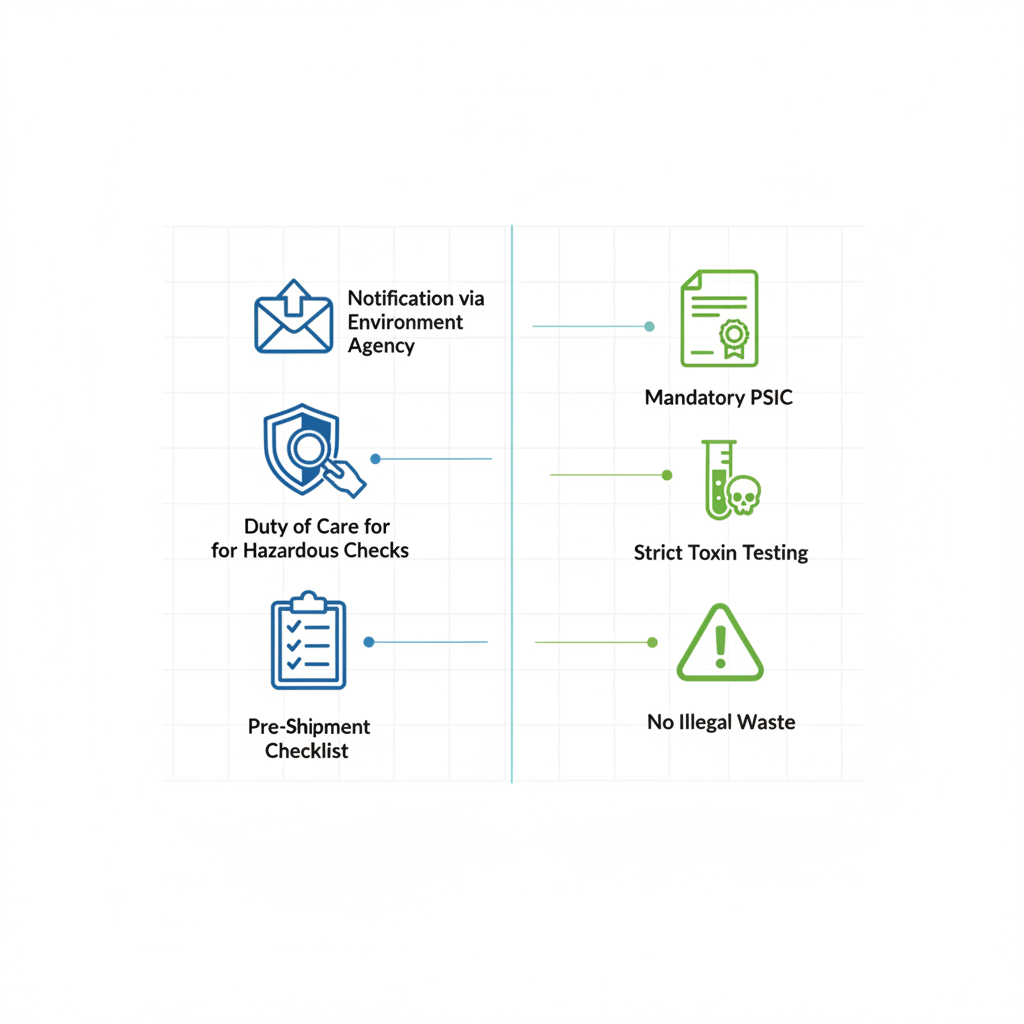
Visual guide to pre-shipment inspection fundamentals for UK scrap exports
Such comparisons underscore the value of integrated compliance strategies for smooth operations.
Role of Pre-Shipment Inspection Agencies (PSIA)
A Pre-Shipment Inspection Agency (PSIA), like those approved by the DGFT, plays a pivotal role in export scrap verification in Britain. These agencies conduct impartial assessments, issuing Pre-Shipment Inspection Certificates (PSIC) that certify consignments are contamination-free. For metal and paper scrap, PSIA responsibilities include quality analysis, such as alloy composition checks for scrap metal inspection, and screening for toxins or radioactivity. Selection criteria for a PSIA involve accreditation, experience in UK ports, and familiarity with bilateral agreements. By leveraging PSIA expertise, exporters mitigate risks and enhance credibility with international buyers.
Basic Process of Pre-Shipment Scrap Inspection
The pre-shipment scrap inspection process begins with booking an appointment at the loading port, typically 48-72 hours in advance. Inspectors then perform physical examinations, including random sampling from containers for laboratory analysis. Key steps involve:
- Documentary review: Verifying export permits, bills of lading, and waste descriptions against the duty of care code.
- Quality and safety checks: Testing for hazardous materials and ensuring scrap purity, as per PSIC standards.
- Certification issuance: Upon approval, the PSIA issues the PSIC, enabling loading and clearance.
This structured approach, known as pre-loading waste certification, ensures compliance and facilitates efficient trade. Exporters should prepare detailed inventories to streamline the procedure, avoiding delays in high-volume ports in England.
Detailed Process of Scrap Inspection in UK Exports
Scrap inspection services in the UK play a crucial role in ensuring that exported waste materials meet international standards for safety and environmental compliance. As a DGFT-approved Pre-Shipment Inspection Agency (PSIA), companies like Melt Enterprise Ltd facilitate these detailed waste export checks in Britain by conducting thorough verifications at loading ports. This process safeguards against hazardous contaminants and supports smooth global trade, particularly for metal and paper scrap shipments originating from UK hubs.
Booking and Preparation for Inspection
The initial phase of port-based scrap verification begins with booking an inspection through a licensed PSIA. Exporters must submit a formal request via online portals like the International Waste Shipments (IWS) service, as outlined in UK government guidelines on importing and exporting waste. This involves providing details on the consignment, including waste type, quantity, and destination, to initiate notification controls for regulated shipments.
Preparation requires compiling essential documentation, such as the Annex VII form for green list wastes or full application forms for hazardous or non-standard materials. Exporters ensure site readiness at UK ports like Felixstowe by organizing the scrap into accessible lots, segregating types, and preparing movement documents, including contracts with treatment facilities and financial guarantees. Under the Waste Duty of Care Code of Practice, producers verify that waste descriptions are accurate to avoid delays. This step typically takes 7-14 days for consent from competent authorities, emphasizing the need for early planning to align with shipping schedules.
Common preparations include labeling consignments clearly and coordinating with port operators for secure storage. Non-compliance here can lead to rejected bookings, so exporters often consult PSIA experts for guidance on classification under the retained Waste Shipments Regulation.
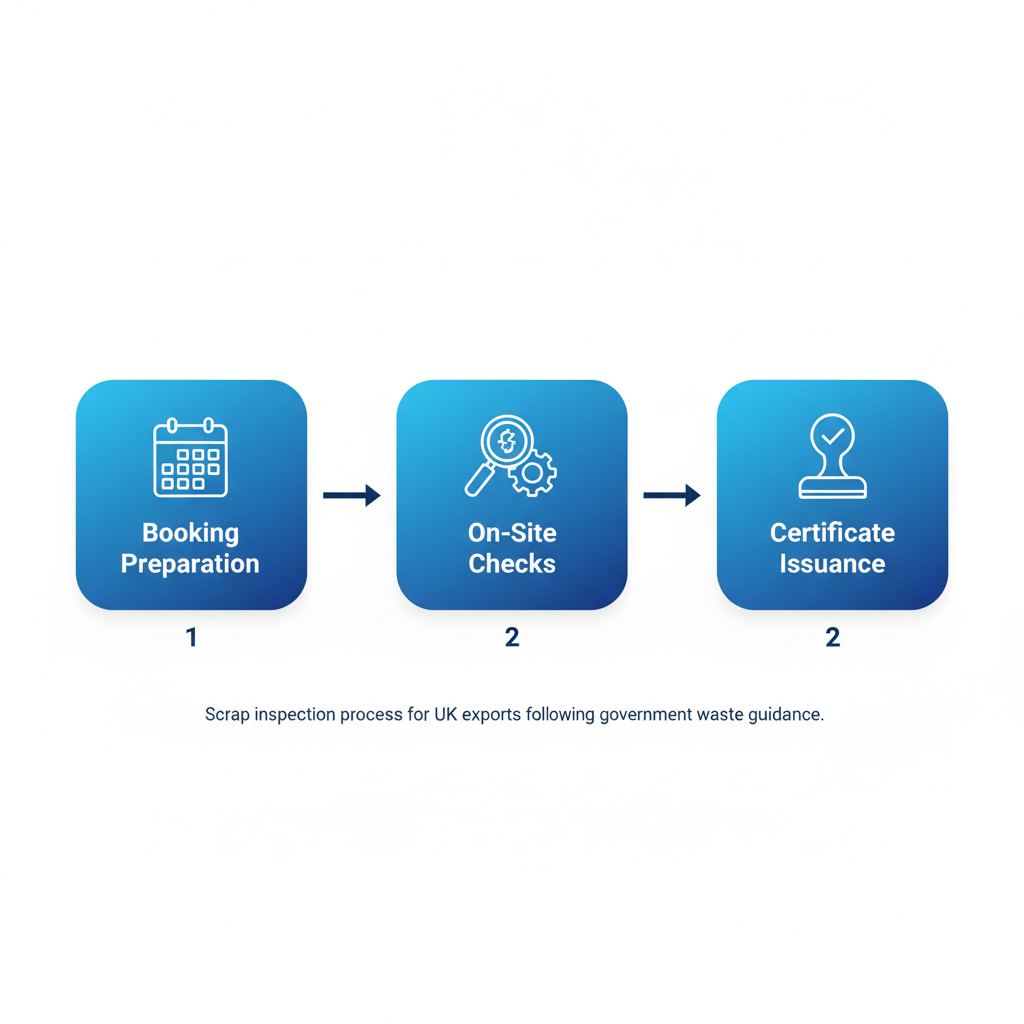
Detailed process flow for scrap inspection in UK exports
This visual overview highlights how booking flows into on-site activities and culminates in certification, providing exporters with a clear roadmap for compliance.
On-Site Physical and Quality Checks
Once booked, on-site inspections commence at the loading port, focusing on hands-on methods to detect contaminants and ensure quality. Inspectors from a PSIA arrive to perform scrap metal inspection for ferrous and non-ferrous loads, using protocols from UK waste export guidelines. The process starts with visual assessments to identify mixed wastes or improper sorting, followed by random sampling across containers.
Adaptation to scrap type is key; metal scraps require checks for embedded hazards, while paper demands verification of purity levels. Selection of methods depends on the waste’s classification–notification controls trigger rigorous testing for international destinations, as per government protocols at ports like Felixstowe.
The following table outlines inspection methods for different scrap types:
| Method | Metal Scrap | Paper Scrap |
|---|---|---|
| Physical Inspection | Visual sorting and sampling at port | Density checks and contamination scan |
| Laboratory Testing | Hazardous material analysis (e.g., radiation) | Chemical composition for recyclability |
These approaches ensure comprehensive coverage, with physical methods providing quick overviews and lab tests confirming detailed compliance.
Efficiency trade-offs arise in method selection: physical inspections are faster and less costly, often completing within hours, but may miss subtle contaminants requiring lab confirmation. Laboratory testing, while more expensive–potentially adding £500-£2,000 per consignment–offers definitive results for high-risk exports, balancing speed against regulatory certainty. Delays from non-compliance, such as undetected radiation in metals, can halt shipments, underscoring the value of integrated approaches.
Testing incorporates tools like Geiger counters for radiation in scrap metal inspection and spectrometers for composition analysis. Sampling follows duty of care practices, retaining records for two years on non-hazardous waste. UK port protocols emphasize safety, with inspectors trained to handle potential hazards during these checks.
Issuance of Pre-Shipment Certificates
Following successful on-site verification, the pre-shipment scrap inspection phase concludes with certification issuance. Inspectors compile findings into a detailed report, grading the consignment for quality and confirming absence of prohibited materials, aligned with Waste Shipments Regulation requirements.
- Report Finalization: Data from physical and lab tests is reviewed, with any issues flagged for remediation–such as re-sorting contaminated lots.
- Certificate Generation: The PSIA issues the Pre-Shipment Inspection Certificate (PSIC), detailing compliance metrics, waste description, and test results. This document, required for banking and customs clearance, includes signatures from authorized personnel and references duty of care verifications.
- Post-Inspection Support: Exporters receive digital copies within 24-48 hours, along with guidance on documentation for transit authorities. For complex cases, consultancy on amendments or refunds for notifications is provided, ensuring seamless export.
This step supports exporters by mitigating risks of shipment rejection, particularly for destinations with strict import rules. In UK contexts, PSICs from approved agencies like Melt Enterprise enhance credibility, facilitating faster customs processing and reducing overall export timelines.
Applying Scrap Inspection Practices in UK Exports
Implementing effective scrap inspection services in the UK is essential for exporters of metal and paper scrap to meet international compliance standards, particularly for destinations like India. By focusing on DGFT-approved agencies, thorough documentation, and proactive challenge management, businesses can streamline their export processes, reduce risks, and ensure smooth shipments. This section provides actionable steps to integrate these practices into your operations, drawing on official guidelines to support reliable execution.
Selecting a DGFT-Approved Inspection Agency
Choosing the right Pre-Shipment Inspection Agency (PSIA) is a critical first step in arranging scrap inspection services in the UK. With regulatory requirements tightening under frameworks like the Waste Shipments Regulation, exporters must prioritize agencies with proven credentials to avoid delays and penalties. Evaluating options based on DGFT approval, experience in metal and paper scrap, and operational coverage ensures your consignments receive accurate verification, aligning with export consent processes outlined in UK government guidance.
The following table compares key selection criteria for top UK-based PSIAs, highlighting differences that impact efficiency for scrap exports:
| Criteria | Melt Enterprise | Generic Agency |
|---|---|---|
| DGFT Approval | Yes, for India exports | Varies |
| Port Coverage | UK-wide, including London | Limited |
| Certification Speed | Within 24-48 hours | 3-5 days |
Opting for a DGFT-approved agency like Melt Enterprise offers distinct benefits, such as expedited certifications and comprehensive port access, which are vital for time-sensitive shipments. These providers ensure compliance with notification controls, including financial guarantees and movement documents, reducing the likelihood of customs holds. By selecting a specialized firm, exporters gain access to quality testing and consultancy, ultimately lowering long-term costs through fewer rejections and enhanced trading reliability.
Preparing Documentation and Consignments
Proper preparation is key to successful scrap metal inspection during exports from the UK. Start by compiling essential documents as per UK export guidelines, including waste transfer notes, exporter notifications via the International Waste Shipments service, and contracts with treatment facilities. For India-bound shipments, secure DGFT consents early, detailing the waste’s origin, composition, and journey to meet notification control requirements. These steps prevent common pitfalls and facilitate smoother pre-shipment verification.
Next, organize your consignment site for efficient inspection. Segregate metal and paper scrap by type to minimize contamination risks, using covered storage areas to protect against weather exposure. Implement practical UK waste checks by labeling bundles clearly and conducting internal audits beforehand. A simple checklist can streamline this: 1) Verify sorting accuracy; 2) Prepare packing lists with weight and volume details; 3) Arrange secure access for inspectors at ports like London Gateway. Cost-saving tips include batching consignments to reduce per-unit inspection fees and using digital tools for document submission, which can cut processing time by up to 30 percent.
For export prep verification, ensure all hazardous materials are excluded, as green list controls under Article 18 apply only to properly sorted non-hazardous waste. Accompany shipments with the Annex VII form and maintain records for audits. This thorough approach not only speeds up approvals but also builds trust with international partners, supporting repeated successful exports.
Handling Common Inspection Challenges
Even with careful planning, pre-shipment scrap inspection can encounter hurdles like contamination discoveries or port delays at UK facilities. If inspectors identify impurities in metal scrap, request immediate re-testing to verify findings, often resolving issues within hours if documentation supports your claims. For delays, common at busy ports like Felixstowe, proactive scheduling with your PSIA–aiming for 7-10 days before loading for India routes–helps maintain timelines.
Address documentation gaps by cross-referencing against government consent processes, such as securing all competent authority approvals upfront. Cost-saving strategies include contingency budgets for minor re-inspections, typically 5-10 percent of total fees. By anticipating these challenges and partnering with experienced agencies, exporters can turn potential setbacks into opportunities for refined processes, ensuring consistent compliance and operational efficiency.
Advanced Topics in UK Scrap Inspection Compliance
Delving deeper into scrap inspection services in the UK reveals sophisticated layers of compliance essential for exporters navigating complex international trade. Beyond basic protocols, advanced practices ensure adherence to stringent environmental and safety standards, particularly for hazardous materials in scrap shipments. As global trade intensifies, these methods safeguard against penalties under the UK’s Waste Duty of Care Code of Practice, which mandates rigorous documentation and verification for waste handlers to protect human health and the environment.
In the realm of scrap metal inspection, the need for advanced tools arises from the increasing scrutiny on contaminants that could pose risks during export. Traditional visual checks fall short for detecting trace elements or radioactivity, especially in mixed metal loads destined for recycling abroad. The Waste Duty of Care Code emphasizes that waste producers and carriers must verify material descriptions accurately, retaining records for up to three years for hazardous waste. This underscores the importance of precise testing to prevent offenses that could lead to fines or prosecution, aligning with duties for controlled waste like industrial scrap.
The following table compares key hazardous screening techniques:
| Technique | Application | Accuracy Level |
|---|---|---|
| XRF Analysis | For metal composition | High for elements |
| Radiation Detection | For radioactivity in scrap | Essential for safety |
These techniques integrate seamlessly into the Pre-Shipment Inspection Certificate (PSIC) process, where results from XRF analysis or radiation detection inform the final certification. For instance, confirmatory spectrometry data supports declarations of non-hazardous status, enabling DGFT-approved agencies to issue reliable documents that facilitate smooth customs clearance. This integration not only enhances export certification but also reduces liabilities for exporters by providing verifiable evidence of compliance.
Expanding to global nuances, pre-shipment scrap inspection extends beyond India to destinations like the EU and Southeast Asia, requiring harmonized standards under extended producer responsibilities. Multi-destination compliance involves auditing PSIA performance against varying import regulations, such as the EU’s Waste Framework Directive, to ensure traceability. Premium testing fees for these advanced services typically range from £500 to £2,000 per consignment, reflecting the specialized equipment and expertise involved–addressing queries on costs for DGFT-approved inspections from the UK.
Looking ahead, trends in sophisticated UK scrap analysis point to emerging regulations on recycling standards, driven by sustainability goals. Digital tracking technologies, like blockchain for supply chain visibility, promise to streamline logistics integration, allowing real-time monitoring of scrap from origin to port. Forward-looking PSIA operations will likely incorporate AI-driven analytics for predictive compliance, ensuring exporters stay ahead of evolving duty of care requirements and fostering circular economy practices.
Frequently Asked Questions on UK Scrap Inspections
For exporters navigating scrap inspection services in the UK, this UK scrap Q&A addresses common concerns about pre-shipment processes and compliance.
What are the key requirements for scrap metal inspection in the UK?
Exporters must ensure scrap meets the retained Waste Shipments Regulation (EC No 1013/2006). This includes proper sorting, non-hazardous content verification, and documentation via the International Waste Shipments service, as outlined in UK government guidance.
How do I arrange a pre-shipment scrap inspection?
Contact a DGFT-approved agency like Melt Enterprise to schedule physical checks at the loading port. Provide details on waste origin, treatment, and destination for timely coordination.
Is a Pre-Shipment Inspection Certificate necessary for exports?
Yes, PSIC confirms consignments are free from hazardous materials, aiding customs clearance and documentary compliance for banks and authorities across global trade lanes.
What does a typical scrap inspection involve?
Procedures include visual examination, sampling for quality analysis, and testing for contaminants. Export inspection FAQs emphasize verifying no hazardous elements like radioactivity or chemicals.
What are the costs associated with UK scrap inspections?
Fees vary by shipment volume and waste type, starting from notification applications. Refer to UK government guidance on importing and exporting waste for detailed charges, including financial guarantees.
Key Takeaways for UK Scrap Export Inspections
Scrap inspection services in the UK are vital for ensuring essential UK scrap compliance during exports. Key fundamentals include rigorous pre-shipment scrap inspection processes and scrap metal inspection to verify material quality, free from hazards, while adhering to regulations like the Waste Duty of Care Code of Practice for ongoing environmental protection and documentation retention.
Practical tips emphasize timely PSIC issuance by DGFT-approved PSIA, offering cost-effective final export verification notes that prevent fines and delays. Engage certified agencies like Melt Enterprise Ltd for seamless operations, reinforcing all compliance essentials addressed throughout this guide.